

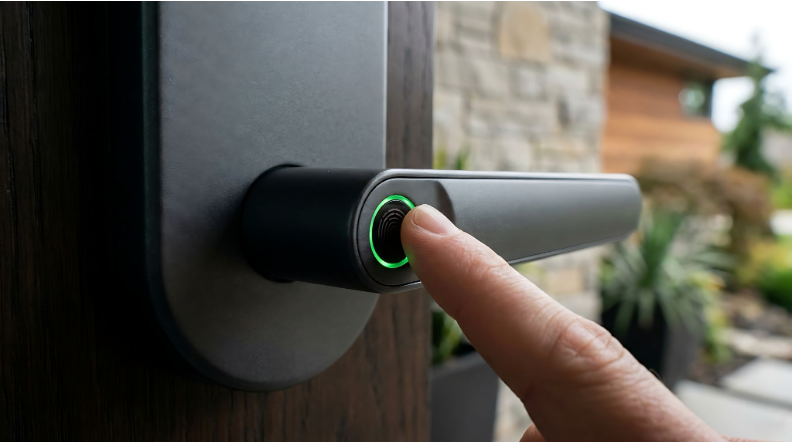
Picture this: you are approaching the front door with arms full of bagged groceries. Instead of fumbling for your keys or reaching down to enter a six-digit PIN code, you simply press your finger against the lock. It opens, and you walk in. Sounds incredibly easy, doesn’t it? It is.
Thanks to significant advancements in biometrics, it’s now possible to install a smart lock that you access with just your finger. Biometric smart locks are not the standard yet, but I imagine it will not be much longer before they are. They are just too convenient to ignore. Given the chance, would you use one?
How Fingerprint Smart Locks Work
Fingerprint locks utilize advanced biometric sensors built directly into the lock trim or door handle. The device scans the unique ridges, valleys, and points of your fingerprint and compares them with a stored image linked to your account. As long as the two match, you are given access.
Note that the images being used are not like literal pictures. Instead, modern smart locks use capacitive sensors to measure tiny electrical charges that map your fingerprint. The map comprises geometric data points that are converted into a mathematical algorithm. Both the algorithm in storage and the one the smart lock produces are compared as data sets.
Advantages of Biometric Smart Locks
Smart locks with numeric keypads represented a huge step forward for home security according to Vivint, a nationwide leader in smart home automation. They offered homeowners a way to dispense with keys and still access their locked homes. But now, biometrics are replacing numeric keypads for multiple reasons.
1. Eliminating Shoulder Surfing
One of the numeric keypad’s inherent vulnerabilities is potential ‘shoulder surfing’. Someone looking over your shoulder can watch you enter your PIN code and memorize it. Fingerprint locks eliminate that risk.
I should point out that many fingerprint locks also come with a numeric keypad, but that keypad can be reserved for temporary guests. Scanning your fingerprint when someone is next to you eliminates the possibility of shoulder surfing.
2. Eliminating Visible Wear and Tear
Another vulnerability of the numeric keypad is visible wear and tear. Over time, constant use causes the numbers on some of the keys to wear away. A skilled burglar can get a good idea of the four digits in your PIN code if you don’t change it regularly.
3. Faster, Frictionless Access
On a more positive note, biometric smart locks are faster and frictionless. It’s a lot easier to press your thumb against the lock than stop to enter a PIN code. No doubt fingerprint scanners are faster and more convenient than physical keys.
4. Child and Senior Friendly Simplicity
If you have young kids or seniors living in your home, giving them PIN codes may not be the best idea. PIN codes can be forgotten too easily. With a fingerprint smart lock, there is nothing to remember. Every member of your household can gain access simply by pressing a thumb against the lock.
Think It Through Before You Buy
This post might give you the idea that fingerprint locks are the best solution for smart home security. That might not be true in every case. If you are thinking about installing smart locks, take a look at all of your options. Get the details and think things through before you make a purchase decision.
If a fingerprint lock is the best option for you, go for it. But if a lock with a numeric keypad would better serve your family, most modern smart locks still have one.